🎸 Guitar Theory Fundamentals
Master the basics of guitar playing with our comprehensive guide
Types of Guitars
🎸 Acoustic Guitar
Features a hollow body that naturally amplifies the sound of the strings. Perfect for folk, country, and singer-songwriter styles. The steel strings produce a bright, loud tone ideal for strumming and fingerpicking.
🎵 Classical Guitar
Uses nylon strings that produce a warm, mellow tone. Has a wider neck and is commonly used for classical music, flamenco, and bossa nova. Easier on the fingers for beginners due to softer strings.
⚡ Electric Guitar
Requires an amplifier to produce sound. Uses magnetic pickups to convert string vibrations into electrical signals. Essential for rock, metal, blues, and jazz. Offers various sound effects and tonal possibilities.
Parts of the Guitar
Headstock
The top part of the guitar where the tuning pegs are located. Used to adjust string tension and tune the guitar.
Tuning Pegs
Mechanical devices that hold the strings and allow you to adjust their pitch by tightening or loosening them.
Nut
A small strip of material (plastic, bone, or metal) at the top of the neck that guides the strings and maintains proper spacing.
Neck
The long, thin part of the guitar where you press strings to create different notes. Contains the fretboard and frets.
Fretboard
The flat surface on the neck where you press down the strings. Usually made of rosewood or maple.
Frets
Metal strips embedded in the fretboard that divide it into half-step intervals. Pressing behind a fret changes the pitch.
Body
The main part of the guitar that amplifies the sound (acoustic) or houses the electronics (electric).
Sound Hole
The circular opening in acoustic guitars that allows sound to project from the hollow body.
Pickups (Electric)
Magnetic devices that capture string vibrations and convert them to electrical signals on electric guitars.
Bridge
Anchors the strings to the body and transfers string vibrations to the soundboard or pickups.
Saddle
A small piece on the bridge that supports the strings and helps transfer vibrations to the body.
Strings
Six strings tuned to E-A-D-G-B-E (from thickest to thinnest). They vibrate to produce sound when plucked or strummed.
Musical Scales
Major Scale
What is a Major Scale?
The major scale is the foundation of Western music. It has a bright, happy sound and is used in countless songs across all genres.
W = Whole step (2 frets)
H = Half step (1 fret)
Minor Scale
What is a Minor Scale?
The natural minor scale has a darker, sadder sound compared to the major scale. It's commonly used in blues, rock, and emotional ballads.
W = Whole step (2 frets)
H = Half step (1 fret)
Basic Guitar Chords
These are the essential chords every guitarist should learn first. Master these and you'll be able to play thousands of songs!
How to read chord diagrams:
- X = Don't play this string
- O = Play open string (no fingers)
- Numbers = Which finger to use (1=index, 2=middle, 3=ring, 4=pinky)
- Vertical lines = Strings (E A D G B E from left to right)
- Horizontal lines = Frets
C
Major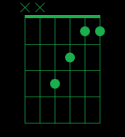
Fingers: 1st-B, 2nd-D, 3rd-A
G
Major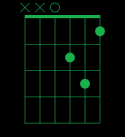
Fingers: 2nd-A, 3rd-E, 4th-e
D
Major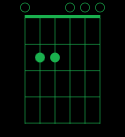
Fingers: 1st-G, 2nd-e, 3rd-B
A
Major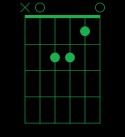
Fingers: 1st-D, 2nd-G, 3rd-B
E
Major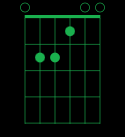
Fingers: 1st-G, 2nd-A, 3rd-D
Am
Minor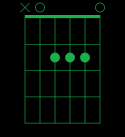
Fingers: 1st-B, 2nd-D, 3rd-G
Em
Minor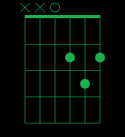
Fingers: 2nd-A, 3rd-D
Dm
Minor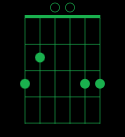
Fingers: 1st-e, 2nd-B, 3rd-G
F
Major (Barre)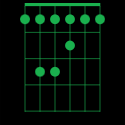
1st finger bars all strings